
For 70 years, 90 families from the Shaikh community have brought their dholki-making tradition to Kalyan for the Ganapati festival, celebrating culture and unity.
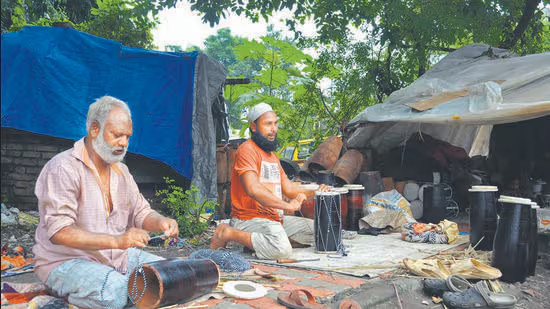
Kalyan, India – August 07 2025: Members of the Shaikh (Dholki Wali) community from Moradabad, Uttar Pradesh, craft and sell traditional dholkis in Kalyan during their annual visit—preserving a 70-year legacy of rhythm, craftsmanship, and cultural connection through generations. August 05.. Pic on Thursday in India on 07 2025 – Story By Anamika Gharat ( Photo By Pramod Tambe).
THANE: Every year, for the last 70 years, 90 families from the Shaikh community in Moradabad, Uttar Pradesh, arrive in Kalyan just before the Ganapati festival. They come here with one mission — to make and sell traditional hand-made dholkis, a percussion instrument that adds a magical rhythm to the Ganapati festivities.
From the moment the Ganesha idol arrives, to the aartis, and the final visarjan, or immersion, the beats of the dholak drum up festive cheer. It’s as if their rhythm pulses through the heart of the city.
These families, from the ‘Dholkiwali’ community, live in Kalyan for about a month. In that short time, they bring with them not just their instruments but a rich legacy of tradition and hard work passed down through generations. In the narrow lanes of Bail Bazaar in Kalyan West, where these families live, the sound of hammers, ropes and laughter fills the air. Their presence is not just about selling dholkis, it’s a cultural exchange, a passion for art, and the joy of togetherness.
Mohammad Hasan, a 65-year-old dholki maker, has been coming to Kalyan since he was 15. “Our seven generations have never missed a single year,” he says proudly. “The Ganapati festival is very important to us. We bring our material – wood and leather – from our village, where other family members help prepare it. Our dholkis are strong enough to last 5-6 years, if handled well.”
Hasan recalls learning to make dholkis when he was a child. “We never went to school, but we played with tools and wood from a young age. Identifying good wood for dholaks became our game,” he laughs. “Now, when we cut wood, we plant trees.”
The entire village back in Moradabad is involved in the craft. Dholki-making is not just a profession, it’s their identity. Men, women, and even children from the community take part in this annual journey. They don’t just sell dholkis but also play them during local events and Ganapati celebrations. Many are invited to homes and pandals to perform, adding vigour and rhythm to every aarti and procession.